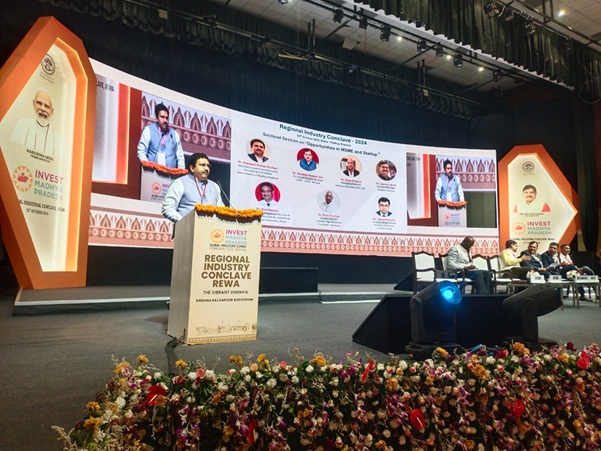
Event Title: Regional Industry Conclave - Rewa
23-Oct-2024
To 23-Oct-2024
Regional Industry Conclave - Rewa
1.Event Background
The Government of Madhya Pradesh with the objective of encouraging investment and promotion of the industrialization at regional level organising Regional Industry Conclaves at Regional levels. In the line, Regional Industry Conclave – Rewa was held on 23rd October 2024 at Krishna Raj Kapoor Auditorium, Rewa. The objective of the participation of the Department of MSME in the conclave were:
-
Promote the investment in the MSME sector
-
Connect with potential investor and stakeholders
-
Promote the Startups in the regions
-
Highlight the Opportunities in MSME and Startup
Under this event, the Department of MSME Participated and Presented in the Inaugural session, organized a sectoral session on Opportunities in MSME and Start-Ups and setup the Departments Stall.
2.Inaugural Session Presentation
Dr. Navneet Mohan Kothari, Secretary-cum-Commissioner of MSME, Department of MSME, GoMP, presented the opportunities in MSMEs and start-ups, highlighting the MSME and start-up scenarios at the state and regional levels, along with the supporting ecosystem and focusing on opportunities.
The presentation was attended by HCM Shri Dr. Mohan Yadav and CS Shri Anurag Jain, along with other ministers, industrialists, entrepreneurs, government officials, and other participants.
3.Sectoral Session
Session - Opportunities in MSME and Start-Ups
Rewa division is gifted with abundance of agriculture produce and mineral resources which gives it an inherent potential to be a prominent growth driver of the State. The Division provides ample opportunities for entrepreneurs to explore opportunities in all three – manufacturing, service and trading segment. Moreover, the presence of Large industries in the Division pave a way to enhance the growth of entrepreneurs as ancillary segment. Naturally, all this is leading to growth of MSMEs and Start-ups in the Division. However, there are challenges which are acting as roadblocks in this growth trajectory.
In this regard, the Department organized a sectoral session which engaged sectoral experts as panellists to dwell on this issue and explore the solutions.
List of Panellists
-
Dr Navneet Mohan Kothari – Secretary cum Commissioner MSME
-
Mr Rajeev Khanna – Managing Director, Khanna Polyweave Pvt. Ltd.
-
Prof. Atul Pandey – HoD, Awadhesh Pratap Singh University, Rewa
-
Dr Sandesh Kumar Jain – Principal Director & Head, CIPET Bhopal
-
Mr Qamar Javed – General Manger, NABARD
-
Dr. Moni Thomas – Director & CEO, JR-ABI Jabalpur
Moderator
Mr. Jayant Prakash – Director, Ernst & Young LLP
Event Flow
-
Dr. Kothari set the context of the session by explaining how a unit can be classified as an MSME. He then stressed its importance in the economy by highlighting its contribution to GDP and employment generation. He also emphasized the critical role of MSMEs in the growth of large industries as their ancillary/vendor units. He then elaborated on the advantages Madhya Pradesh has due to its strengths in location, demographics, and policy initiatives like the MP MSME Development Policy 2021, MP Start-Up Policy, and Implementation Scheme 2022. He then introduced the panel.
-
Mr. Jayant Prakash spoke about the MSME ecosystem and how approximately 98% of MSMEs are classified as micro enterprises. Hence, the issues plaguing the micro enterprise segment—such as access to finance, markets, and talent—are also affecting the entire sector.
-
Mr. Qamar Javed explained the banking perspective of this issue. Access to finance for MSMEs from the organized segment comes from banks that are mandated by the RBI to lend under the priority sector and non-priority sector segments. However, banks are still lending low amounts per capita under the priority sector. NABARD has an Agri Infra Fund that initially covered warehouses and now also covers MSMEs. The bank also funds GI facilitation centers to support GI products. The District Development Manager of NABARD will support e-commerce.
-
Dr. Sandesh Kumar Jain explained how the Central Institute of Petrochemical Engineering and Technology, Centre for Skill and Technical Support in Bhopal, supports the MSME ecosystem. CIPET is well-equipped with testing facilities and tool making. It has an incubation cell with 3D printing and 3D scanning for product development. The institute also facilitates high-end project collaboration and helps troubleshoot issues related to MSMEs.
-
Mr. Rajiv Khanna underlined the importance of an industry-friendly environment, subsidy assistance, and friendly labor policies in driving the growth of industry in the state. He lauded the initiative taken by the Department of MSME in organizing this session and hoped that more such sessions would be arranged in the future, which would benefit the industry scenario in the region and the state.
-
Mr. Atul Pandey started by explaining how a start-up, with innovation at its heart, is different from other forms of entrepreneurship and business. He talked about the GOI’s initiative for start-ups—Start-Up India 2016—which was launched to build a strong ecosystem for nurturing innovation and start-ups in the country, driving economic growth and generating large-scale employment opportunities. This initiative focuses on process simplification, handholding, financial support, and industrial-academia partnership and incubation. With this help, a start-up with an idea that can address problems can scale up to become a unicorn and, further, a major market player. For example, Abhinav Dubey of Chai-Sutta Bar married the concept of chai with the sustainability of kulhad cups. Thus, he addressed the livelihood issue of traditional earthen artisans with tea as a solution. This idea was embraced outside India too when Chai Sutta Bar opened in Dubai, Muscat, and Canada. Today, Chai Sutta Bar stands at a valuation of Rs 150 crore and reflects the state’s own indigenous entrepreneurial growth story.
-
Dr. Moni Thomas explained how start-ups can be used to address issues in the agriculture sector. Eighty-five percent of marginal farmers are always in trouble. Start-ups can address these issues through their innovation. The Jawahar RKVY Raftaar Agribusiness Incubator supports the journey of a start-up from the ideation stage to the assessment stage (Prerna) and then to the expansion stage (Sakaar). At the ideation stage, only selected agripreneurs from a batch of 30 in the orientation program will be allowed to benefit from the Pre-Seed Stage Grant-in-Aid of Rs. 5 lakhs. An amount of up to Rs. 25 lakhs are given for start-ups in the expansion stage to reach a commercial level.
4.Exhibition
The Department of MSME set up a stall displaying its scheme provisions on panels and standees, along with brochures and in-person assistance to address the queries of existing MSMEs, startups, and potential investors.
Start-ups which put their Stalls
-
Rupika Food & Agriculture Pvt Ltd – Agri Based Start-up and Govt of India recognized
-
Radhe Gopal industries – Under Arms and Sweat pad manufacturers. Govt of India recognized
-
Rewa State Firms – Millets Based Products. Govt of India recognized.
-
Saatvik Enterprises – Cow Dung Products. Govt of India recognized.
-
Wegrow Naturally Pvt Ltd – Organic Products. Govt of India recognized
-
Indo Essence Agrotech – Agriculture consultancy. Govt of India recognized
-
Beti Innovative Pvt Ltd- Parali Management (Mushroom). Govt of India recognized
-
Vastek System Solutions- Recruitment Services. Govt of India recognized
-
Shri Lalta Industries – Masala Products. Govt of India recognized
5.Way Forward
The respective DTICs will follow up on investment proposals and assist potential investors in establishing their businesses by supporting them with land arrangements, statutory clearances, applications, verification, and the distribution of benefits under Departments schemes and programs.
 Last Updated on 07-11-2025